
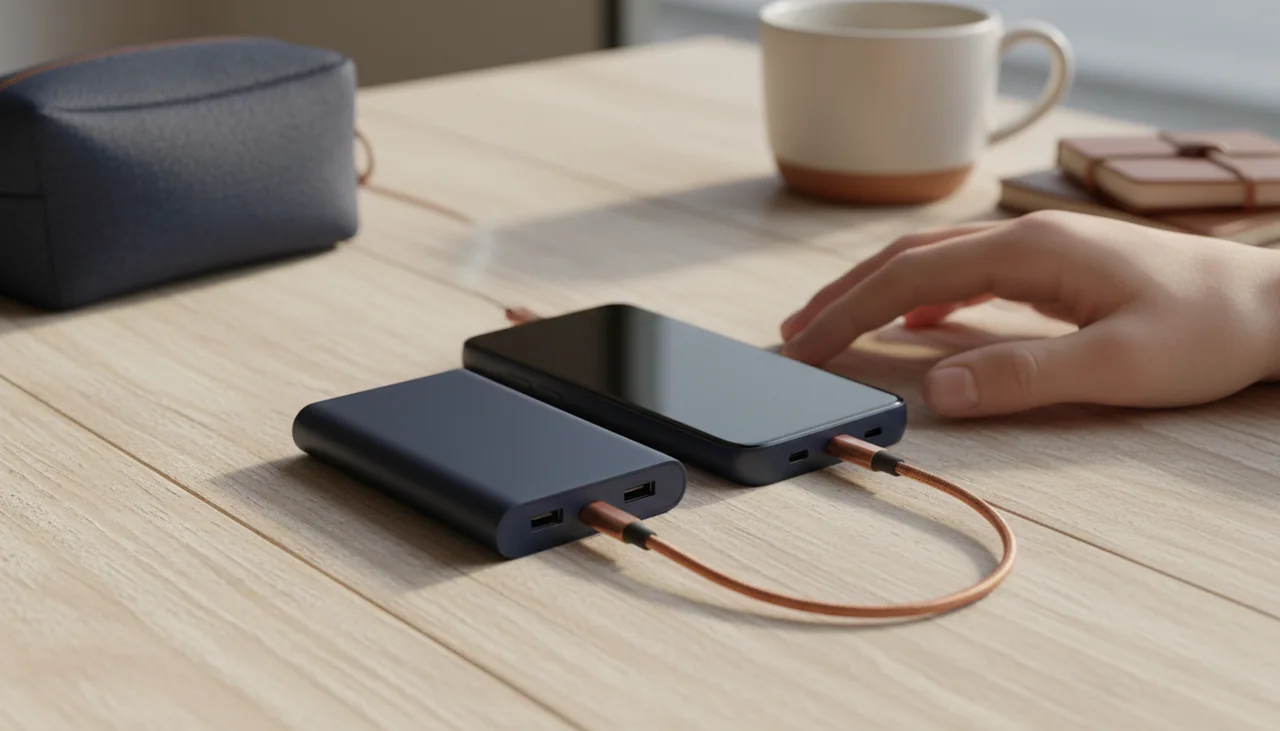
On a city trip your phone is your map, ticket, camera, translator and payment tool all at once. That makes the battery a resource that directly affects your plan in the middle of the day. Running out of charge while you check the ferry timetable in Istanbul, or while you look for the way back in the evening, is more than a small hiccup. Fortunately, the fix is not expensive equipment but a small setup that you put together once before you leave in the morning.
The basic setup that stretches the day
The list is short and all of it fits in a small bag. What matters is to prepare it once and find it in the same place every morning.
- A power bank whose capacity covers your daily need
- A short charging cable; it does not tangle in the bag and is easy to use standing up
- A wall charger that supports fast charging at the hotel
- In Turkey the socket type is C/F and the mains voltage is 230 V; if you are coming from a country with a different type, you will need a suitable plug adapter
- Power banks must be carried in cabin baggage; check the airline's capacity limit in advance
Making a habit of charging the power bank at the hotel every evening means you do not have to think about it when you leave in the morning. Carrying an empty power bank is the same as carrying none at all.
Protecting the battery through the day
Carrying charge matters, but so does cutting consumption; together they get you to the end of the day comfortably.
- Leaving screen brightness on automatic reduces unnecessary drain in the sun
- Closing apps you are not using limits consumption, especially those that use location
- Photography and navigation are the two biggest drains; on days when you use both for long stretches, keep the power bank in the top compartment of your bag
- Turning on power-saving mode in the middle of the day makes it easier to last until the evening
- In places with a weak signal the phone uses more power; if you will be in such an area for a long time, switching to flight mode helps
Extreme heat also strains the battery. In summer, not leaving your phone directly in the sun or in a hot car is a good habit for both performance and safety.
Connection: local SIM, eSIM or Wi-Fi?
All three have their place, and the choice depends largely on the length of your trip and how much connection you need.
- On a short trip, hotel and café Wi-Fi together with an offline map are often enough
- On a longer trip, a local SIM or eSIM gives you a constant connection
- Setting up your eSIM before you leave is more practical than sorting it out at the airport
- If you are coming from abroad, check your own operator's roaming charges beforehand
Not carrying out sensitive transactions such as banking on public Wi-Fi networks is a general security habit. Making sure the network name really belongs to that business is also a simple but effective check.
Preparation that works even when the connection drops
There may be places in the city where the signal weakens; inside a covered market, some sections of the metro or busy tourist areas are examples. So part of your plan needs to work without internet too.
- Download an offline map of the area you are heading to
- Save the hotel address and booking details as screenshots
- Download tickets and bookings to your phone in advance
- Note down the numbers you would call in an emergency; in Turkey the emergency number is 112
- Writing the hotel address on a small piece of paper does the job when the phone is completely dead
In short
An uninterrupted city day comes not from big equipment but from a small setup: a power bank charged every evening, a short cable, a map downloaded for offline use, power saving switched on in the middle of the day and a backup plan that works without internet. With those ready, your phone stays with you until the end of the day.